
Concord City Directory Holdings by Year
Concord's verified directory shelf is a set of dated snapshots, not a continuous master list. The sequence moves from a combined Alameda and Contra Costa volume to a telephone book, a county directory, and three R.L. Polk volumes. Early books may place Concord in a county section; later ones give alphabetical resident or business entries. The table separates confirmed digital items from local shelf years that still need catalog verification.
| Collection | Years | Where Held | Access |
|---|---|---|---|
| Alameda and Contra Costa directory | 1871-72 | Archive.org scan | Free online item |
| Sunset Telephone and Telegraph directory | February 1904 | Archive.org scan | Free online item |
| Contra Costa County Directory | 1908 | Archive.org scan | Free online; classified residents near printed page 923 |
| R.L. Polk Richmond and Contra Costa County Directory | 1913-14 | Archive.org scan | Free online; Concord begins on page 379 |
| R.L. Polk Richmond and Contra Costa County Directory | 1914-15 | Archive.org scan | Free online; compare repeat names and streets |
| R.L. Polk Richmond, Martinez, and Contra Costa County Directory | 1916-17 | Archive.org scan | Free online; useful beside the 1920 census |
| California city directories and phone books | Exact Concord years need verification | California State Library, California History Section | Call slip or database check |
No authoritative online inventory confirms a continuous later Polk run, a reverse or criss-cross run, or a final printed year for Concord. The Contra Costa County Historical Society says its library includes directories but does not publish a year list. Ask the Concord Library, History Center, and California State Library to verify a missing year before treating it as lost. A catalog gap is not proof that no book was printed.
For a local shelf check, start with the Concord Library branch page when confirming branch access, catalog coverage, or a directory year that is not visible in a digital scan.
Use the branch reference as an access lead, then record the exact call number or database name supplied by library staff so another researcher can repeat the lookup.
Note: A verified item, a local shelf reference, and a complete publication run are three different levels of evidence.
Concord's Directory Timeline
This city directory timeline moves from the 1871-72 county volume to the 1904 telephone book, 1908 county book, and R.L. Polk volumes. Concord incorporated as Todos Santos in 1905, so early title language needs context.
- 1871-72: The Alameda and Contra Costa directory supplies an early county-wide snapshot.
- February 1904: Sunset Telephone and Telegraph publishes a phone directory with a different emphasis from a resident list.
- 1908: The Contra Costa County Directory includes a classified list of Concord residents near printed page 923.
- 1913-14: R.L. Polk's volume opens the Concord department on printed page 379 and gives fuller person entries.
- 1914-15 and 1916-17: Two later Polk volumes allow year-to-year comparison, though they do not establish a continuous later run.
Record the title, year, printed page, and section each time so a clue can be tested against census, newspaper, deed, and obituary evidence.
Archive Scans for Concord City Directories
Archive.org makes three early Concord artifacts easy to compare. The 1871-72 scan is county-wide, so use its index or Concord section.
Open the 1871-72 Alameda and Contra Costa directory scan for the earliest verified item.
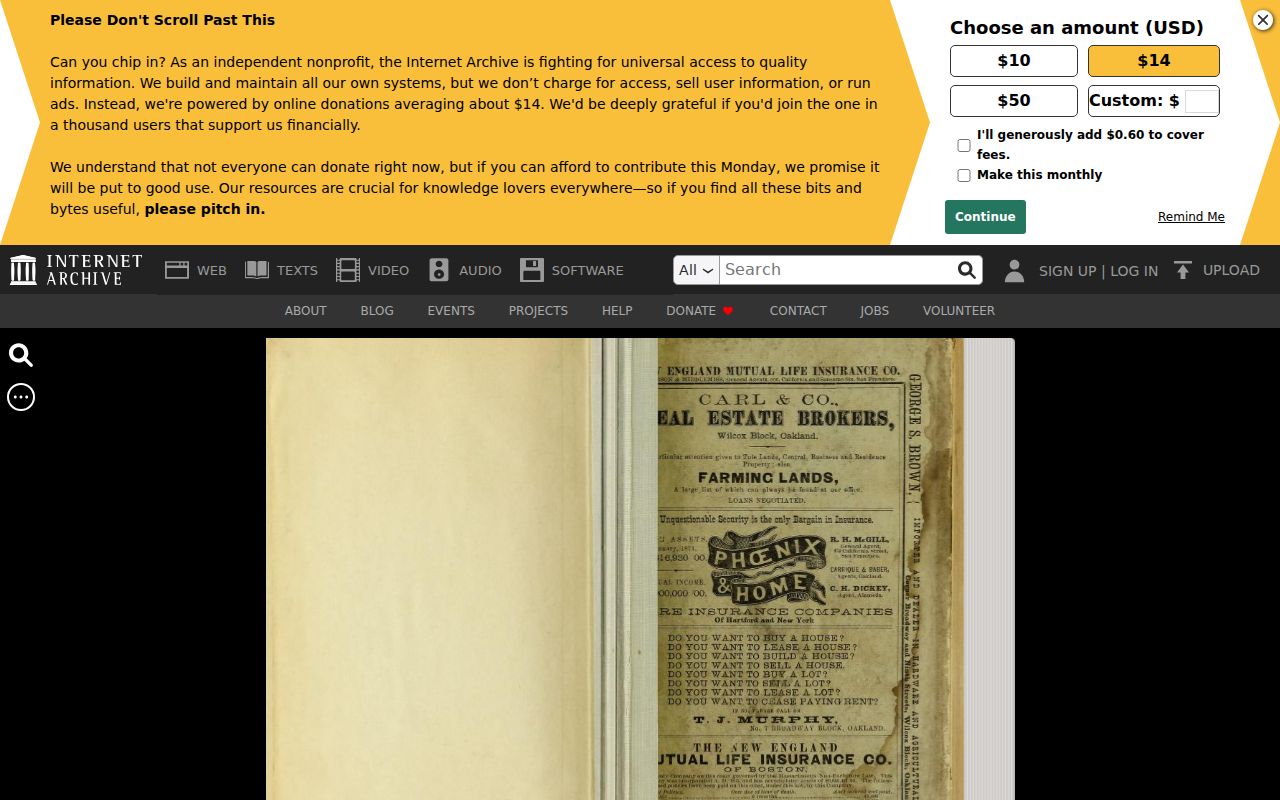
Save the town label, page heading, and index entry because the book is county-wide.
Next, open the February 1904 Sunset Telephone and Telegraph directory scan.
Its phone-book format differs from Polk's fuller resident entries.
The 1908 Contra Costa County Directory scan contains classified residents near printed page 923.
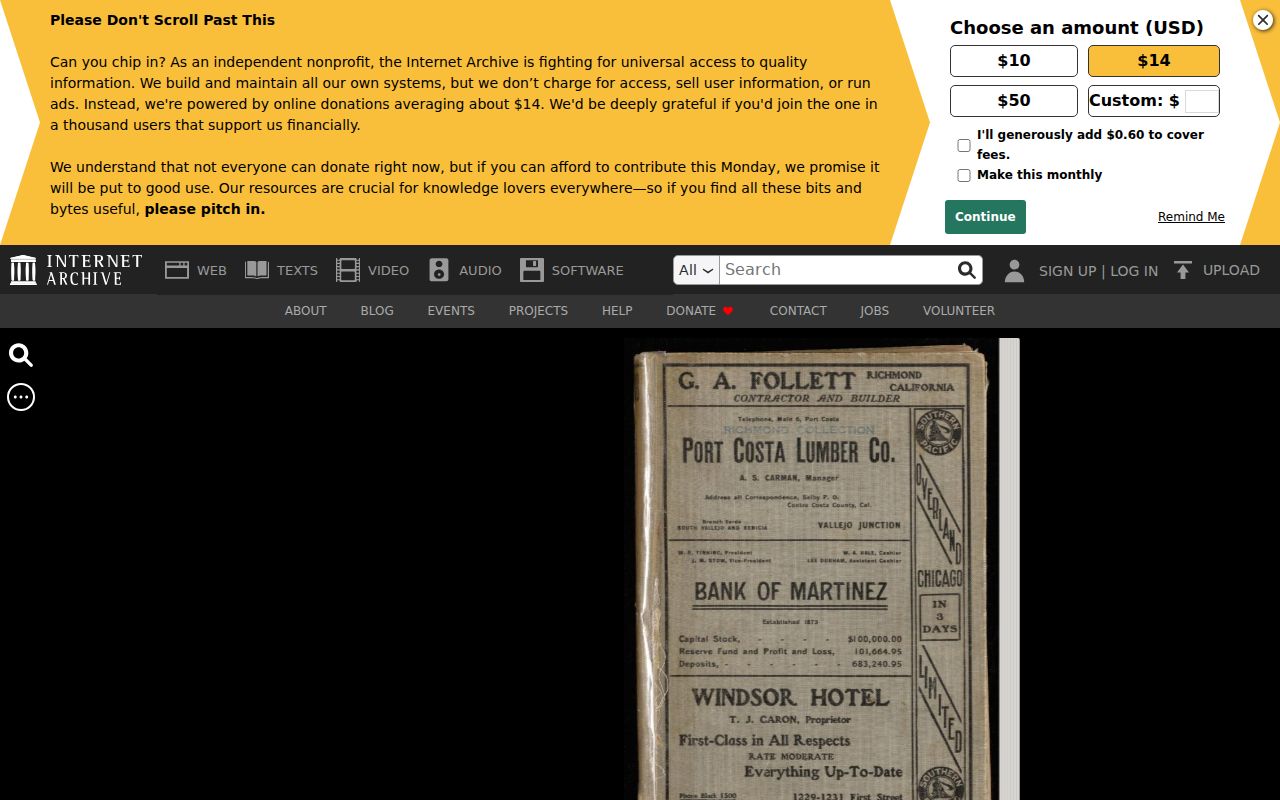
Read that list as the publisher's chosen descriptions, not a complete count of Concord.
Inside the 1908 Concord Directory
The 1908 classified list near printed page 923 is lean. Entries give a name followed by an occupation or status, including farmer, winemaker, widow, and justice of the peace. A short line gains value when tied to a later address, census household, or newspaper notice.
The 1913-14 volume adds spouse parentheses, an occupation and firm, and short residence and cross-street codes. A name in both books may look unrelated because the 1908 line is spare while Polk supplies family and street context.
Banks, churches, and other organizations may list officers or locations rather than households. Advertisements preserve street corners and telephone numbers, but they are not alphabetical resident entries.
Read a Concord City Directory Entry
The 1913-14 Concord department begins on printed page 379. Each entry compresses facts into one line. Copy it first, then expand only marks supported by the volume.
| Name | The entry begins with a surname and given name or initials, such as “Adams Wm B.” |
|---|---|
| Spouse | A spouse appears in parentheses, as in “Adams Wm B (Mercedes).” |
| Occupation and firm | “elec Matheson & Keller” or “carp” follows the name and household clue in the cited samples. |
| Residence mark | r means the following street is the person's residence, as in “r Colfax.” |
| Boarding relation | b indicates boards with or at a named person, as in “b Antonio Anzorio.” |
| Street position | nr means near a cross street, cor means corner, and “r same” returns to the listed place. |
| Widow notation | “wid Wm E” identifies the widow notation in “Ballenger Elizabeth E (wid Wm E).” |
| Status marks | The verified samples use r and b; no universal ownership symbol is documented for these Concord entries. |
“Alloway Fred J (Eleanor) carp r Bonifacio nr Galindo” combines spouse, trade, residence, and a near-street location. “Avila Manuel M grocer Grant nr Lincoln r same” returns the residence to the business place. “Ballenger Elizabeth E (wid Wm E) librarian r Bonifacio cor Galindo” adds widow and corner clues. Small marks can separate namesakes.
Concord Directory Detail Changes
Comparing adjacent runs is more useful than treating one line as final. The 1908 list tends to name a person and status or occupation; the 1913-14 Polk entries add household, firm, and street clues. The 1914-15 and 1916-17 books test whether those clues persist or change.
Start with the short 1908 line, find the same surname and given-name pattern in Polk, then compare spouse, street, firm, and residence or boarding marks. A changed occupation or missing line does not prove a move or death. Editorial choices, spelling, coverage, or an unlocated year may explain it.
When a historical line needs a modern identity check, the Concord resident lookup workflow can connect it to current official records without turning the old entry into a present-day certainty.
Note: Keep the original spelling and initials beside every normalized search form; directory typography can hide a namesake.
Trace a Household Through Concord City Directories
Pair each directory year with a federal census year. Search surname and initial variants, then follow address and household clues instead of a name alone. The verified Concord sequence runs from 1908 through 1916-17, with 1910 and 1920 schedules filling the larger gaps.
- Find the first line: Search 1908, 1913-14, 1914-15, and 1916-17 for surname variants, given-name initials, and the Concord department.
- Copy the clues: Record spouse parentheses, widow wording, occupation, firm, residence street, cross street, and any boards-with relationship.
- Pair the years: Compare the 1908 and 1913-14 entries with the 1910 census, then compare 1916-17 with the 1920 census.
- Repair the place: Test old street names, newspaper notices, deeds, and Sanborn footprints when a number or street does not line up.
- Close the gap: Check a nearby directory year, obituary, probate index, or cemetery source before deciding what a missing entry means.
The National Archives at San Francisco offers onsite partner-database access and federal census, naturalization, immigration, and military records. Schedules currently run through 1950 under the 72-year rule; the 1960 release is expected in 2032. A directory is a point-in-time clue, while a census is an enumeration-date household snapshot.
If a name disappears, compare the last street with the next spouse or relative. Newspapers, probate, and obituaries may explain it, but absence alone cannot.
Sanborn Maps Repair Old Concord Addresses
Directory streets make more sense on a building map. The Library of Congress Sanborn Maps collection lists eight Concord editions: September 1891, January 1897, December 1903, February 1908, February 1912, February 1917, November 1926, and November 1945, items sanborn00477_001 through sanborn00477_008.
Maps show footprints, use, materials, and street context. The 1912 and 1917 sheets pair with Polk; 1926 and 1945 show later change. A map supports place continuity, not every household.
Second Street became Bacon Street and Maltby Avenue became Park Avenue, and old numbers did not align with modern ones. Compare the legal description, footprint, and old name before calling a missing line a move.
Follow Concord's Newspaper Title Chain
Newspapers bridge directory editions. The Contra Costa County Library holdings list The Transcript from 1905-1910, Concord Transcript from 1911-1958, Daily Transcript from 1958-1967, and Concord Transcript again from 1967-1995.
Online windows are limited: January-December 1905, January-December 1907, July 1909-March 1910, and December 1910-November 1923. Walnut Creek microfilm spans 1905-1995 with listed gaps; NewsBank community-library coverage begins January 1996. Change the title search when a run stops.
Search a street, spouse, firm, or widow clue. Obituaries, legal notices, school items, and civic reports may explain a change. Concord Library can help locate catalogs, newspapers, yearbooks, and genealogy databases.
Note: Online newspaper windows are date ranges, not a promise that every issue or page in the range is present.
Concord City Directory Research at CCCHS
The Contra Costa County Historical Society History Center fills gaps when a digitized volume ends or a shelf year is unclear. It is at 724 Escobar Street, Martinez, 925-229-1042. Hours are Tuesday-Thursday, 9 a.m.-4 p.m., and the first and third Saturday, 10 a.m.-2 p.m. Staff research is $20 per hour for members and $30 for nonmembers after a quote. Begin with the History Center research service.
The Contra Costa History Center collection page points to directories, maps, newspapers, assessment books, family papers, and court files.
CCCHS reports more than 9,300 indexed historic court cases naming over 61,000 people, 1,000+ probate cases, 13,000+ naturalizations from 1850-2008 across 107 volumes, 4,000+ obituary entries, and 1,700+ maps. Physical court copies reach through 1911, with many series into the 1950s; indexes are not all online.
The 1864-1901 Contra Costa Gazette digitization is on two History Center computers; delicate maps may require an appointment. Bring spellings, years, street variants, relatives, and the directory page.
Note: CCCHS collection counts describe index and archive scale; they do not establish a continuous Concord city directory year run.
Louis Stein and Concord's Record Archive
When Contra Costa County shifted early assessment books to microfilm, Louis Stein saved hard-copy volumes. His 1984 donation included 50,000 papers and books, 20,000 photographs and negatives, 500 slides, and 200 maps, forming the county archive's foundation. The story appears in the History Center essay on ownership, people, and property.
Collection descriptions disagree: one presents yearly volumes from 1850-1910, another ends in 1904 with missing years. Preserve that discrepancy. A directory line is a dated listing; an assessment book is property evidence. Neither is a full population register.
The University of the Pacific's Dave and Iola Brubeck Collection contains more than 350 linear feet. Photo Series MS-4 II-1A covers 1890-1939 Ivey family and Brubeck home material, parents, siblings, ranching, and Concord parades. Those papers can add relationships that a brief directory entry only hints at.