
Tracing a Concord Street Address
A Concord address is a starting point. In a street directory search, it resolves to an assessor parcel number, or APN. The Concord map confirms the polygon and street segment. The APN moves into the recorder's deed index, while Concord's permit system adds project evidence. A lawful voter channel may verify a person's own registration or support a qualified request, but it cannot serve as an open street-browse tool. Early directories add dated household clues. Ownership is recorded evidence; occupancy is an inference, so each step needs a record key.
Follow the trail in this order. Keep the Concord address, APN, document, permit, and directory page together; namesakes and old street names can blur results.
- Start with the address in the Contra Costa County Assessor property-information entry point. Address and APN routes are practical because public owner-name search is restricted.
- Carry the APN into CCMap or the Concord Public Parcel Viewer. Confirm the outline, municipality, postal fields, zoning, and nearby polygons.
- Use the parcel as the street anchor. Click relevant polygons one at a time and save each APN instead of guessing where a lot begins.
- Send the APN and acquisition date into the Clerk-Recorder index. The deed supplies grantor, grantee, document key, date, and legal description for the Concord seller chain.
- Search the same location in the Concord Accela permit portal. Select the record type, then use the address or permit number.
- Use California My Voter Status or Contra Costa My Voting Information for the registrant's record. An ordinary visitor cannot enumerate a Concord street.
- Finish with early directories, newspapers, maps, or archive indexes. A person-alphabetical volume is not a verified reverse street list.
Concord Street Directory Layers
A named Concord street crosses systems. Contra Costa County holds land and deeds; Concord holds permits and municipal files. Elections protect voter data; libraries hold dated sources.
The Concord coverage table separates place evidence from person evidence. The same address can recur, but its name means something different in each record type.
| Address record | Custodian | Street clue | Access and fallback |
|---|---|---|---|
| Parcel and assessment | Contra Costa Assessor | APN, situs, land and improvement fields, mailing party where displayed | Address/APN routes; 2530 Arnold Drive counter |
| Tax account | Treasurer-Tax Collector | Account, installment, balance, penalty data | Free APN/situs lookup; not occupancy proof |
| Concord parcel map | CCMap and Concord GIS | Geometry, APNs, roads, zoning, districts, postal fields, adjacent lots | Free map browse; Public Works map and book help |
| Deeds and maps | Clerk-Recorder and Public Works | Parties, dates, document numbers, legal descriptions, map references | Online index; 555 Escobar counter or Laserfiche maps |
| Concord city permits | Concord Permit Center | Address, project, applicant, contractor, status, issue date, inspections | 24/7 portal; drawings have copy limits |
| Voter registration | California and Contra Costa Elections | Own registration or qualified-file residence and precinct data | Self-lookup or approved application; not an open street list |
| Early directories | Library and historical collections | Dated names, occupations, spouses, residences, cross streets | Digitized volumes, library, or History Center research |
The Concord APN bridges map, deed, and permit. A street name can connect an address layer to a directory entry, but it does not create one roster. For records outside a portal, the Clerk-Recorder is at 555 Escobar Street, (925) 335-7900; the Assessor is at 2530 Arnold Drive, (925) 313-7400.
Concord Street Parcels in CCMap
For Concord street work, CCMap is the county map anchor. Address or road search reveals a parcel outline and APN, while layers add roads, jurisdiction, zoning, and district context. The Concord Public Parcel Viewer adds adjacent polygons. Neither map is a legal survey, and owner display may be restricted.
Open the current Contra Costa parcel viewer before the recorder or tax systems. Concord APN, address, municipality, postal city and ZIP, zoning, and district fields are key handoff points.
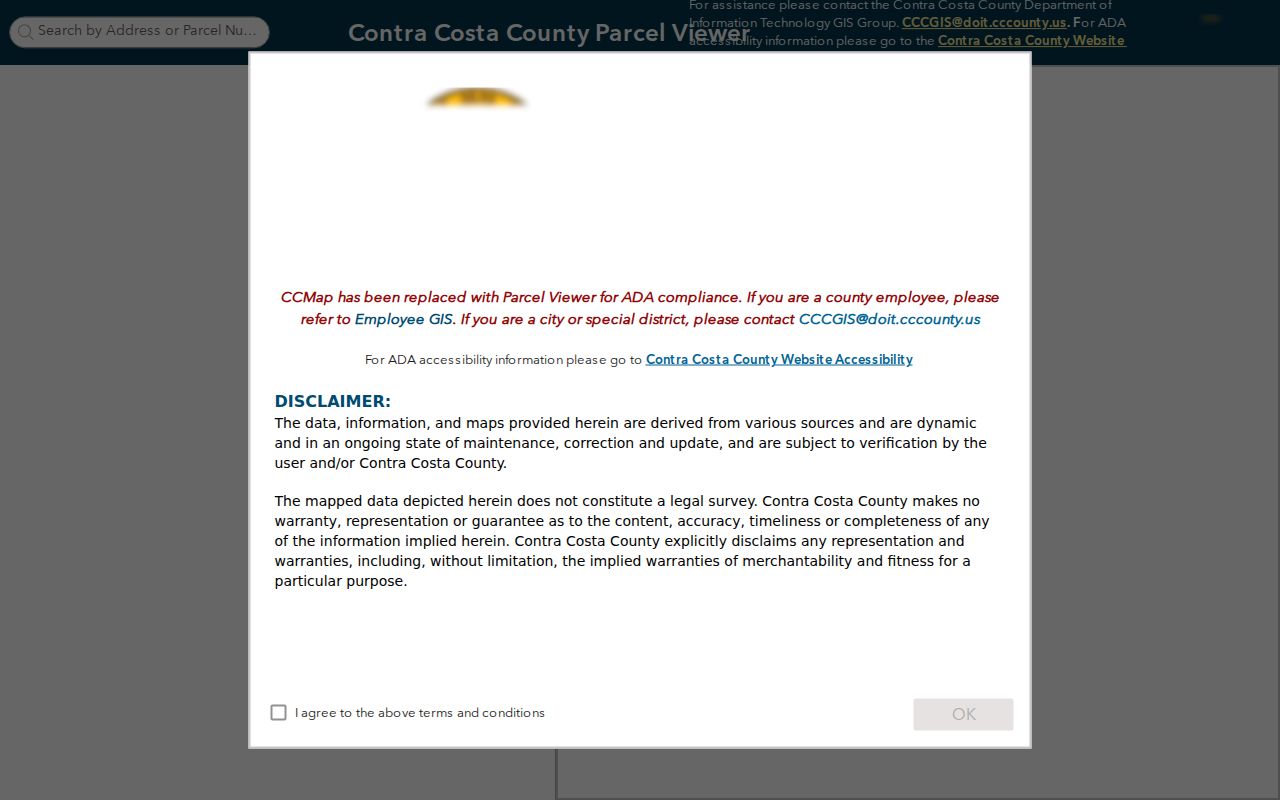
The Concord parcel-viewer image shows why the map step matters. Adjacent shapes can share frontage while carrying separate APNs. Select each polygon, save its key, and search it next.
- Parcel
- A mapped land unit identified by an APN.
- Situs address
- The parcel's physical location, which may differ from its tax mailing destination.
- Plat
- A recorded map linking lot lines, legal descriptions, and parcel books.
- Criss-cross directory
- A street-order directory, unlike Concord's alphabetical early volumes.
Note: An APN is a durable research key, but map lines can change and should not be treated as a legal boundary opinion.
Concord Street Range and Parity Fields
Concord's address service carries more than a label. Its road-centerline layer stores left and right from-to number ranges, parity, community, road class, and ownership. Range fields place an address on a segment; parity indicates the odd or even side. On a Concord segment, those fields help check a corner or street edge.
The Concord address layer separates number components, current and legacy street components, postal community and ZIP, full address, council district, and location type. The Concord service supports ordered, distance, and paged results with a 2,000-record maximum. These fields bridge a modern name to a legacy form, but do not disclose a household list. The Concord GIS maps portal is the city entry point for parcel, street, city-limit, zoning, and related layers.
Situs Address and Tax Mailing Data
Myth. A Concord tax mailing address and a situs address are interchangeable. They are not. The situs is the parcel's physical place. The tax mailing destination is where a bill is sent and may point to a trust, manager, owner, or other contact away from the property. The Concord tax lookup shows account, installment, balance, and penalty data by APN or situs, but payment data does not establish residence.
Compare the Concord tax lookup with the Assessor card, CCMap, deed, and permit history. A Concord applicant or contractor may be tied to a project without owning or occupying the parcel. A deed proves a transfer; a directory captures a dated listing. The safe conclusion is that a record associates a name with a parcel or address, not that the person is every current occupant.
Concord Deeds: APN to Seller
Concord's Clerk-Recorder official-record system is the title trail behind a Concord street directory search. Its APN mode reaches Concord deeds from March 3, 1997; the linked name index banner reaches January 1, 1986. Before those routes, use Old Book or fiche and the free counter index with a party name and approximate year. Some series reach the 1800s, but the online cutoff varies.
For Concord chain research, start with the current parcel and acquisition deed, then search the seller as an earlier grantee. Record names, date, instrument number, book and page when shown, APN reference, and legal description. The Concord Public Works maps and parcel books can bridge an older address.
Insider tip. Start with the current Concord APN deed, then search each seller as an earlier buyer; that handoff is safer than guessing from a postal street name.
The Contra Costa Clerk-Recorder recording portal is the online entry point for Concord deeds. For unclear instruments, use the 555 Escobar counter, (925) 335-7900. Public Works maps are available through its recorded maps system at 255 Glacier Drive.
Note: An index hit identifies a recorded instrument; it is not the same as a certified copy or proof that the named party lived at the address.
Concord Permit Records by Address
Concord's Accela portal adds a project timeline to a Concord parcel trail. Choose Building, Planning, or Engineering, then enter a permit number or address. The route advertises application history, inspection status, and address search. A result can show project address, applicant or contractor, work description, dates, and inspections. It shows city activity, not a full history of people connected to the place.
The table lists key choices; an exact permit number best separates similar addresses.
| Search Application History | Public history mode from the city permit hub. |
|---|---|
| Address or location | Conditional text/autocomplete; enter the full address and verify unit and direction. |
| Permit or application number | Conditional text; best exact key for a known record. |
| Date range or reports | Optional date pair; reports by date range were described as under construction. |
| Status | Display or filter for application and inspection routes. |
See the Concord Permit Center for Building D, 1950 Parkside Drive, and 925-671-3107. The portal is advertised as 24/7. Drawings are inspected there; licensed-design drawings need an affidavit and written design-professional and property-owner approval to copy. County ePermit history from January 1, 1980 applies only to county jurisdiction.
The Concord Accela permit search is the Concord source represented in the image.
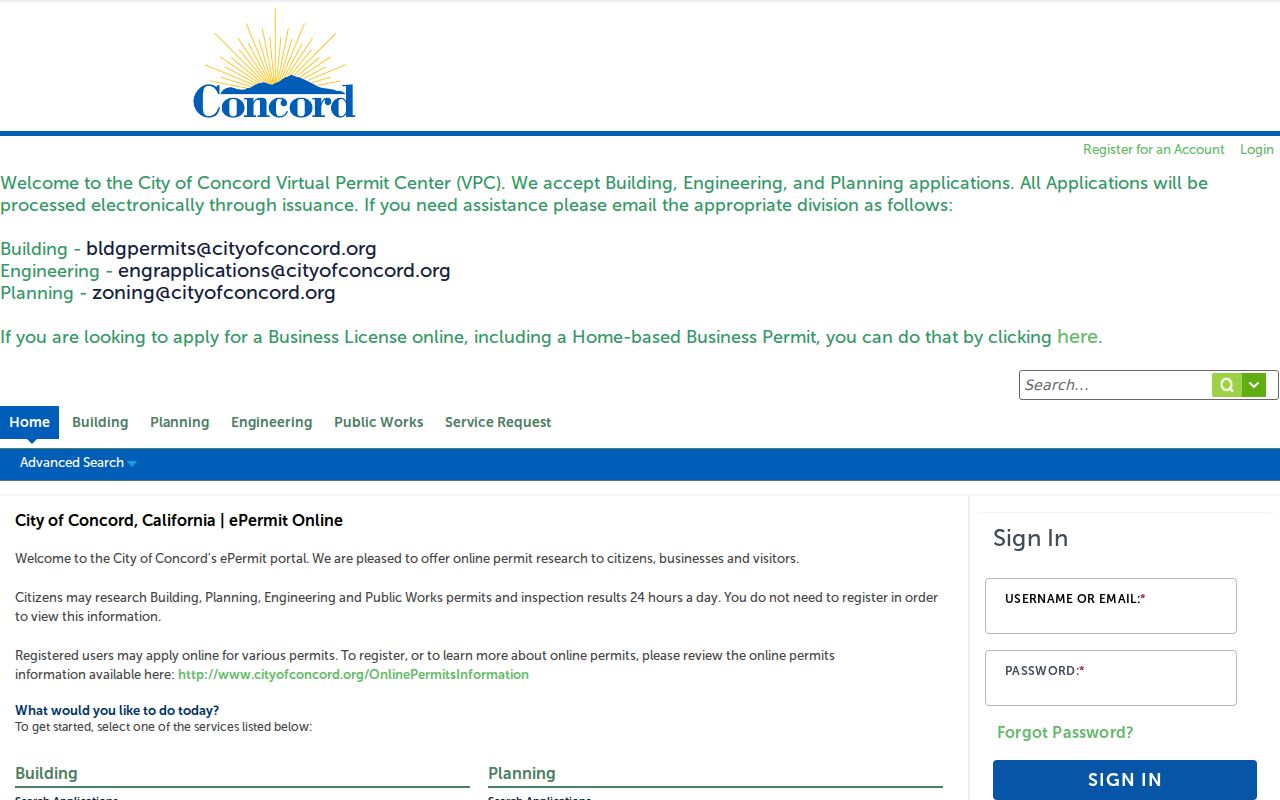
The Concord permit-search image ties the workflow to a city channel. Compare permit number, address, and status with the APN and deed chain before concluding who owns or occupies the parcel.
Concord Street Names Across Time
Old street searches can fail even when the parcel is correct. Concord's city EIR identifies Second Street as Bacon Street and Maltby Avenue as Park Avenue. Older numbers also did not align cleanly. A Concord directory entry using Second or Maltby may point to a modern parcel reached through Bacon or Park.
For Concord history, test both names in the address layer and early directories, then anchor the result to the APN, legal description, map, or Sanborn footprint. The Concord current and legacy fields help, but no authoritative dated renumbering list was verified.
Note: Concord's Second-to-Bacon and Maltby-to-Park changes make legal descriptions and parcel footprints safer anchors than old house numbers.
Concord Street Directory Clues
The early volumes give a street directory search a dated human layer. Verified items include the 1871–72 county directory, February 1904 telephone directory, 1908 Contra Costa County Directory, and R.L. Polk volumes for 1913–14, 1914–15, and 1916–17. The Concord 1913–14 volume begins on printed page 379. Its entries are alphabetical by person or business, not a proven reverse index.
In Concord entries, `nr` marks a nearby cross street, `cor` a corner, `b` a boards-with relation, and “r same” a residence at the business address. Spouse, widow, occupation, and street notes can separate same-name people. The Concord city directory collections page treats the historical volumes in depth; the street task is to use address clues without calling them a current household roll.
For Concord readers, the Concord Library connects to newspapers, yearbooks, local history, and genealogy databases. The Contra Costa County Historical Society History Center in Martinez holds directories, assessment books, maps, obituaries, family papers, and historic court files. Its research channel lists $20-per-hour member and $30-per-hour nonmember work after a quote. No later reverse run was verified, so request a catalog check.
Concord Voter Records and Street Limits
California's voter tools are identity checks, not a public street directory. My Voter Status and Contra Costa My Voting Information ask for fields such as name, date of birth, and county or address details. A matched Concord voter can view registration information. A Concord visitor cannot type a Concord street and browse every registered person.
California Elections Code §§ 2188, 2194, and 18109, Government Code § 7924.000, and related regulations limit voter-file access to approved purposes. A qualified requester may seek a statewide file for $100 or up to ten specified Concord voters at $30 each with the stated cap, subject to current rules. Contra Costa Elections routes Concord questions at 555 Escobar Street, (925) 335-7800. This is a lawful fallback, not a neighborhood-list tool.
Owner, Tax Party, or Occupant?
Concord parcel records can show a named owner or mailing party where California rules allow display. They do not name every person who uses the place. A deed shows a transfer, a tax record a bill relationship, a permit a project participant, and a dated directory a publisher's listing. None alone proves the full current occupancy of a Concord address.
When the question turns to one person, use two independent matches. APN and legal description can anchor a deed party; a court party and co-party can distinguish a namesake; a license or filing can confirm an affiliation without proving a home address. The Concord resident lookup workflow fits that shift.
For an identifiable Concord city or county record not online, the California Public Records Act allows a written, email, mail, or fax request to the Concord department. The Concord agency ordinarily determines within 10 calendar days, with up to 14 more for unusual circumstances. Inspection is generally free; copies use direct duplication or a statutory rate. CPRA does not create a resident list or override voter, vital, court, police, juvenile, sealed, or Safe at Home limits.
What a Concord Street Directory Cannot Show
A Concord street directory cannot reveal a complete list of Concord occupants, relatives, minors, or protected people at each parcel. DMV address data is restricted by the Driver's Privacy Protection Act and California law. Concord utility records are not a public substitute. Safe at Home participants may use a substitute address, and Government Code § 6208.1 restricts publishing participant information.
Use the Concord records trail for lawful personal research such as family history, property history, civic records, or reconnecting through an official channel. Treat every result as dated evidence, not permission to contact anyone. A strong street directory result is a supported parcel and title chain with clear unknowns.
Lawful use. Concord street and address records may support personal research. Do not use a Concord record trail to stalk, harass, threaten, or intimidate anyone; California Penal Code § 646.9 and related laws can apply.
Note: Public access to one record never cancels another record's attached privacy and lawful-use rules.