
Concord Sources for Previous Residents
Previous residents leave different traces by era. The Assessor and county map identify the parcel; the Clerk-Recorder links transfers; directories and census pages add household clues. Permits date work at an address, while newspapers, probate, and local archives can explain a departure or family link. For previous residents, a deed shows a recorded transfer, while a directory or census entry shows a dated listing, not certainty about current occupancy.
| Source | Years It Covers | Where Held | What It Shows |
|---|---|---|---|
| Assessor roll and parcel map | Current roll | Contra Costa Assessor and CCMap | APN, situs, parcel shape, mailing clue |
| Recorder APN deed mode | 3/3/1997-present | Contra Costa Clerk-Recorder index | Deeds tied to APN, parties, dates, document number |
| Recorder name index | 1/1/1986-present banner | Online index and counter | Party roles, type, date, book and page where shown |
| Old Book and counter index | Before 1986; some records to 1800s | Clerk-Recorder legacy books and counter | Earlier party, book, page, and legal-description trail |
| Directories and federal census | 1871-72, 1908, 1913-17; census through 1950 | Concord Library, archives, NARA partners | Residents, spouses, address clues, and households |
| Permit history | City archive; county 1/1/1980-present | Concord Permit Portal and county ePermits | Applicant, project, contractor, issue, and inspection history |
Start with the newest reliable key and step backward. If an online Concord search stops, use the recorder counter or phone line, a targeted county request, and library, archive, or NARA channels.
Concord Previous Residents Start With the APN
Begin with the physical parcel, not a guessed name. The Contra Costa Assessor maintains maps and the annual roll. The county's CCMap viewer searches an address or road, reveals parcel outlines, exposes an APN, and adds road, zoning, jurisdiction, and nearby-lot layers. For a Concord parcel, the APN displays ten digits, such as 123-456-789-0. A situs address marks the parcel; a tax mailing address marks delivery. Neither identifies every previous resident.
Because public owner-name access is restricted, carry the APN to Concord tax, recorder, and Public Works parcel-book systems. Treat a Concord mailing party as a lead, not a household fact. The current address-by-address workflow belongs with the Concord street directory; the backward trail needs a deed, map, or dated household source.
Concord Deeds: Grantor to Earlier Grantee
The recorder's APN mode reaches Concord deeds from March 3, 1997 forward. Open the latest acquisition instrument that fits the parcel, then use its party names and legal description in the name index. That turns names into a documented chain.
- Confirm the Concord APN in CCMap; note the situs, map reference, and acquisition date.
- Search the Concord APN mode; record grantor, grantee, recording date, document number, and legal description.
- Search the seller as an earlier grantee in Name mode, using spelling and date limits.
- Repeat backward, matching legal descriptions rather than postal addresses.
- Before 1986, use Old Book, microfiche, or the free counter index for an older Concord instrument.
Grantor means the transferor; grantee means the recipient. A chain of title is the linked, dated sequence of transfers for one parcel. A legal description is the formal lot, map, survey, or subdivision reference, often more stable than an address after a rename.
- Grantor / grantee
- Transferor and recipient named in the recorded instrument.
- Chain of title
- A dated sequence of linked transfers for one parcel.
- Legal description
- The formal lot, map, survey, or subdivision reference.
- Criss-cross directory
- A reverse directory arranged by address; a continuous local run was not verified.
Concord Name Indexes After 1986
The online Concord name-index banner reaches January 1, 1986. A hit is not a complete deed image, so search both party roles, narrow dates, and save the document number before ordering a copy. Image, redaction, and certification routes may differ.
| Recorder field | How it helps a Concord address history |
|---|---|
| Search or keyword | Starts a Google-like name discovery search; try surname-first variants. |
| Grantor / Grantee | Separates the seller from the prior or later buyer in the chain. |
| Document number and type | Identifies the instrument and distinguishes deeds, liens, releases, easements, or maps. |
| Recording date | Places a transfer in sequence and limits a search for common names. |
| Book / page | Bridges older instruments and citations that predate modern document numbering. |
When Concord results stop online, use the Contra Costa Clerk-Recorder counter at 555 Escobar Street, Martinez, or 925-335-7900. Index and document viewing are described as free; copies and certifications follow current schedules. A targeted CPRA request under California Government Code sections 7920.000-7931.000 may be mailed, emailed, faxed, or spoken to the department. Determination is normally due in 10 calendar days, extendable 14 days, and inspection is generally free.
Earlier Concord Deeds in the Old Books
Before the modern name-index run, use the recorder's Old Book or counter process. Research describes Concord legacy books and some instruments reaching the 1800s. Bring one party, approximate years, and legal or map references. A failed street search does not prove a transfer is absent.
Concord Public Works maps bridge deeds citing a subdivision or survey. The county property-research hub links recorded documents, parcel books, maps, zoning, permits, and assistance. CCCHS holds assessment books and historic maps; ask which series covers the year.
CCCHS says Concord assessment volumes begin in 1850. Louis Stein saved early books when the county shifted to microfilm, and his 1984 donation helped form the archive. Descriptions differ on a 1850-1910 run versus volumes ending in 1904, so verify gaps.
Concord Street Renames That Break the Trail
Old names can make a sound deed chain look broken. Second Street became Bacon Street, Maltby Avenue became Park Avenue, and old numbers did not align cleanly with modern ones. A directory entry at the wrong number may still describe the same parcel.
Reconcile the address by comparing old and current street names, legal description, APN or subdivision map, and Sanborn footprint. Concord's address service retains current and legacy street components, number pieces, postal community, ZIP, neighborhood, and municipality. Use the Concord postal fields to translate a listing, not to treat a postal label or number as a boundary.
For Concord house history, check a cross street, parcel map, permit date, and footprint together. Report aligned evidence, not proof from an old number alone.
Concord Sanborn Views of Earlier Homes
Eight exact Concord Sanborn editions sit in the Library of Congress: September 1891, January 1897, December 1903, February 1908, February 1912, February 1917, November 1926, and November 1945. The Sanborn map collection supplies dated building context when an address changes or a directory gives only a cross street.
Maps show footprints, uses, materials, and address context, not every occupant. Beside a deed and directory, Concord maps can test whether a lot or building persisted. By 1926, north of Bacon had 27 homes and south had seven; by 1945, north had 45 homes plus a hospital and nursery, and south had 13. For Concord, those counts reconstruct a block, not a resident roll.
Concord Households Across Directories and Census
Deeds show transfers; directories and census schedules add dated household clues. Verified Concord items include 1871-72, February 1904, 1908, and Polk volumes 1913-14, 1914-15, and 1916-17. The Concord city directory page covers the collections; address history follows previous residents through each entry's year and place.
The 1908 list often gives only name and occupation or status. A 1913-14 entry can add spouse, occupation, street, and nr, b, or cor codes; Concord begins on page 379. These clues separate names, but absence is not proof of a move or death.
The National Archives at San Francisco genealogy resources provide a federal route for census and related records.
Federal schedules run through 1950 under the 72-year release rule; 1960 is scheduled for 2032. Pair 1908 and 1913-14 with 1910, and 1916-17 with 1920. Search variants in the Concord trail and compare a deed, newspaper, or map.
- Record the Concord directory page, name form, street, and household clues.
- Check the matching census, enumeration district, members, ages, and address wording.
- Compare the next directory for continuity, a street change, or a new relationship.
- Test the result with a deed, map, permit, obituary, or probate file.
Concord Permits Mark Address Changes
Permit history dates changes at a Concord address. Concord's Permit Center, Building D, 1950 Parkside Drive, offers a 24/7 portal for applications, status, inspections, and history. Search a full address or permit number; record the project, applicant, contractor, dates, and inspections. A participant is evidence about a project, not proof of residence.
Concord city fields include address, permit number, date-range reports, and separate application and inspection routes. Counter applications stop after 4 p.m.; phone 925-671-3107. Concord county ePermits covers 1/1/1980-present for county jurisdiction only.
Use the Concord Permit Center online or at the counter. The city Document Center filters date, folder, and document; a targeted Concord request can name the project and date span. Plans are inspected at the Permit Center, and licensed-design copies require stated approvals.
CCCHS Evidence for Concord Previous Residents
Contra Costa County Historical Society History Center in Martinez is a fallback when a Concord address trail leaves the web. It holds government records, newspapers, family papers, obituaries, biographies, directories, maps, assessment books, and historic court files. The listing gives 724 Escobar Street, 925-229-1042, Tue-Thu 9 to 4, and first/third Saturday 10 to 2. Staff research is $20 per hour for members and $30 for nonmembers after a quote. The History Center resource collection shows an archival shelf beyond a modern portal.
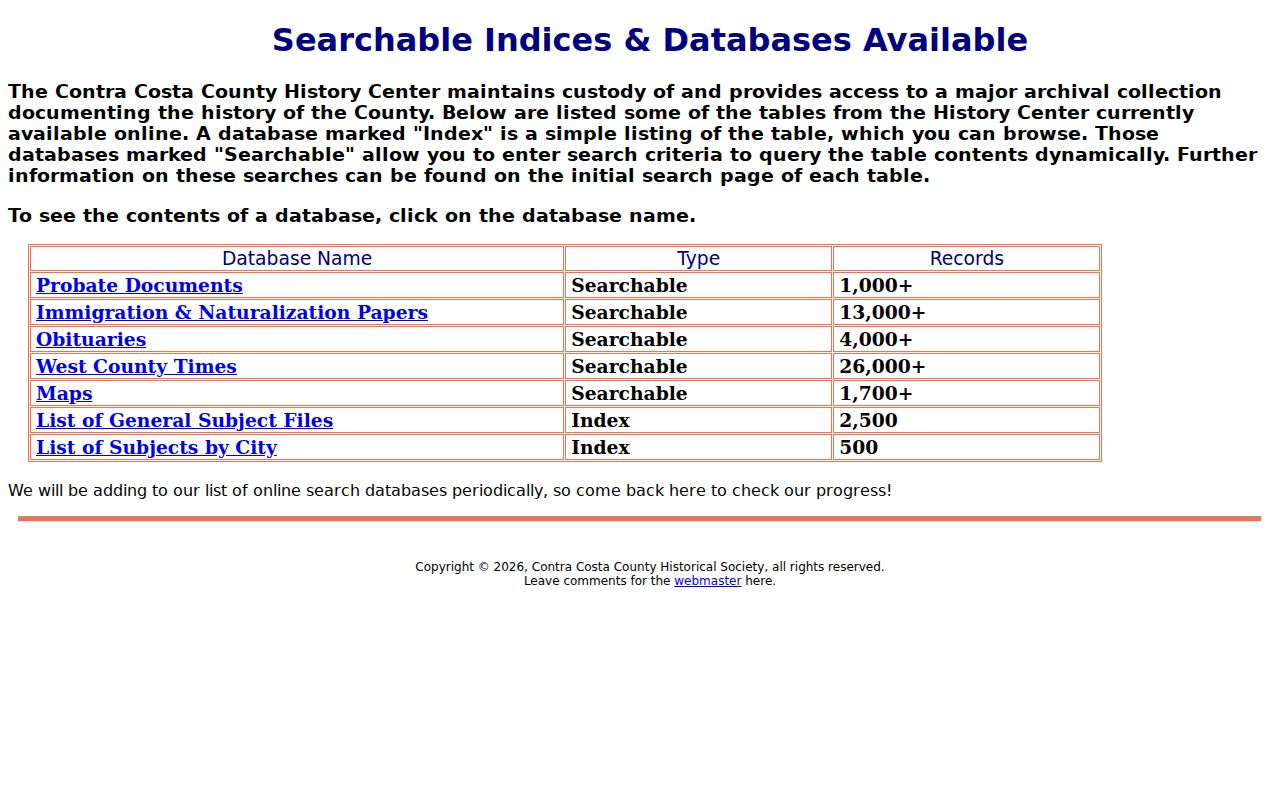
Archive material can connect Concord previous residents with an owner, household, business, and place without proving all four. Bring street-name variants, approximate years, relatives, and every deed or directory citation already found. CCCHS reports 9,300+ historic court cases naming 61,000+ people, 1,000+ probate entries, naturalization records from 1850-2008 in 107 volumes with 13,000+ cases, 4,000+ obituary entries, 1,700+ maps, and 20,000 scanned photographs. Those Concord holdings can solve a gap that a broad web query cannot.
The CCCHS research service provides a separate path for Concord indexes, clippings, court material, and quoted staff assistance.
That route can connect names to an underlying volume or image. Indexes are leads, not substitutes for the file; ask which privacy limits apply.
Concord Obituaries and Probate Endpoints
Newspapers can link a dated address to a later life event. Contra Costa County Library lists The Transcript in 1905-1910, Concord Transcript in 1911-1958, Daily Transcript in 1958-1967, and Concord Transcript again in 1967-1995. Online holdings cover selected months from 1905-1923; Walnut Creek microfilm spans 1905-1995 with gaps, and NewsBank begins in January 1996. The library's historical newspaper holdings show why a title search must account for the paper's name and access method.
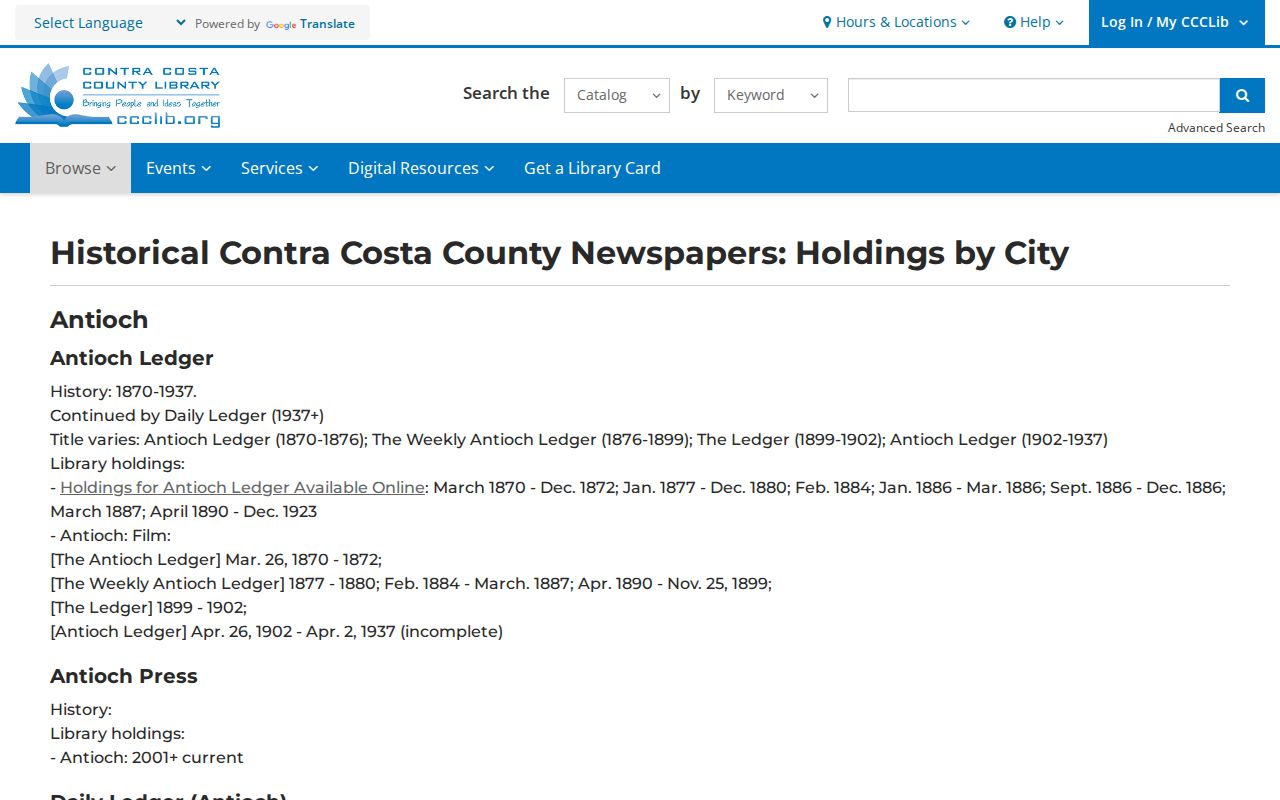
That newspaper shelf can test a Concord name, street, or household connection. Pair an obituary with probate; a notice does not prove ownership. The Contra Costa Superior Court portal covers probate indexes, but documents, minutes, and confidential matters may be absent. Court Records moved to 725 Court Street, Room 103, Martinez, in January 2026; phone 925-608-1000. A deed controls transfer; probate may explain heirs or timing.
Concord previous residents may end in an obituary, probate index, historic court file, or family paper. Check nearby years and surname variants before declaring a gap.
Lawful house history. Concord previous-resident research is appropriate for house history, family history, genealogy, and personal curiosity. California Penal Code section 646.9 and related harassment laws do not turn a public record into permission to repeatedly contact, follow, threaten, or harm a person; protected addresses and confidential records must remain private.